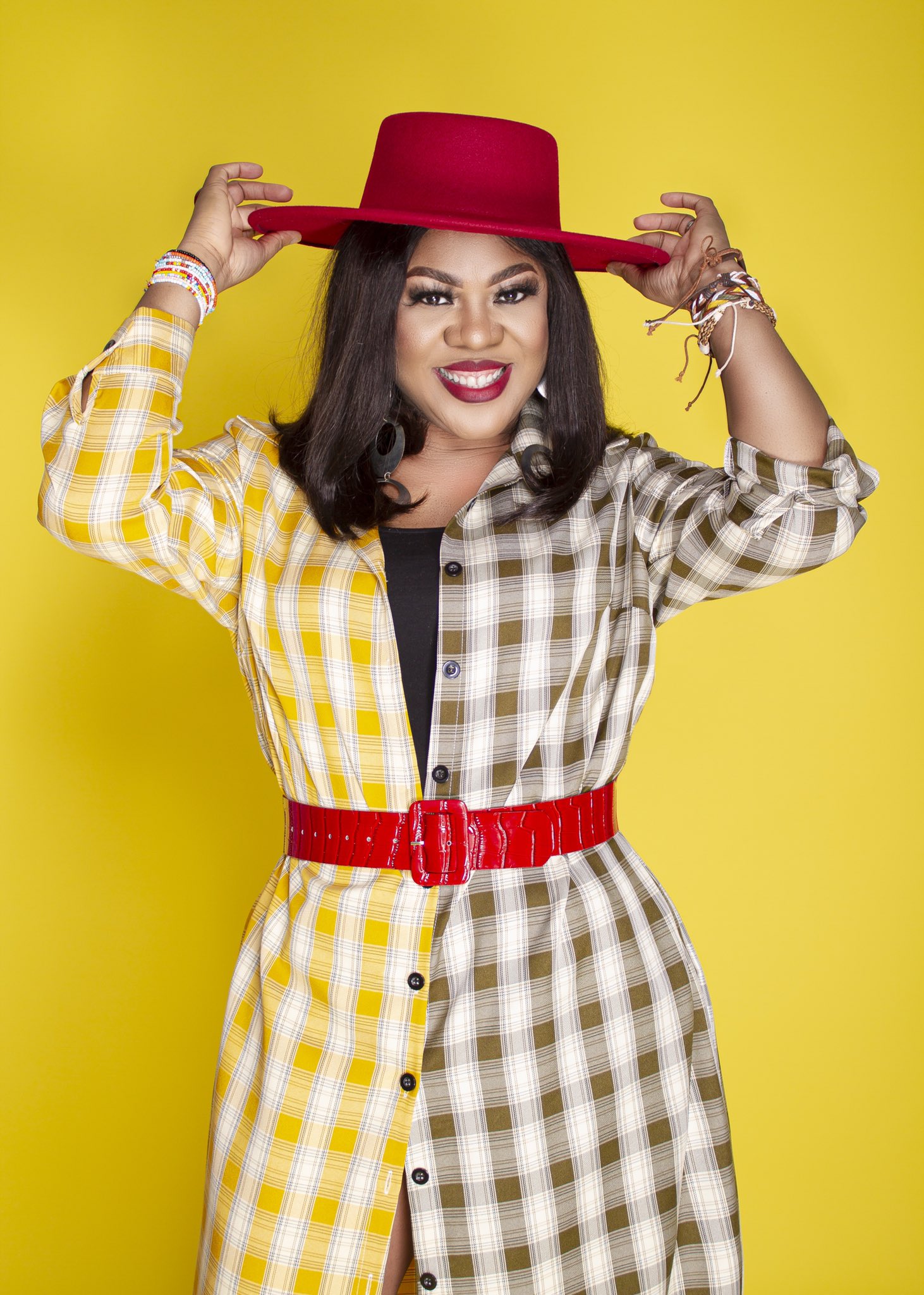
Born on 24th April 1978, Stella Damasus is a Nigerian-born entertainer based in the United States of America. She is most notable for her work as an actress; she has been in the Entertainment Industry for over two decades and has since been considered one of the most famous film actresses from Africa.
A devoted Christian, Stella is a woman with many talents; she is also a Publisher, Dancer, Radio & TV Host, Acting Coach, Vocal Coach, Event Host, Writer, Vlogger, Blogger, Educator, Producer, and Businesswoman.
Stella Damascus is the CEO of ADIVA Networks, a media company. Under ADIVA Networks, she launched her quarterly magazine, ADIVA Magazine. She has also produced content for television and is currently working on a film project. Other services provided by ADIVA Networks include Publishing, Consulting, Events, Training, Mentoring.
In order to alleviate the suffering of the less privileged and help create a better future for others, she set up the Stella Damasus Arts (SDA) Foundation, a non-profit organization established to provide economic, intellectual, and emotional support to the society, using the Arts as its primary tool. The Foundation launched its Free Arts Training Program and opened its doors to its first set of students on the 16th of May 2011.
Stella, an Advocate and Philanthropist has worked with several organizations. Some of which include - Globally Igniting Africa (GIA), a non-profit organization, as their Women's Ambassador. Project Alert to fight against domestic violence. Women4africa, as an Ambassador. WFP (World Food Program) to help the people of Liberia and supports Lamboginny Say No to Crime. She is also is an ambassador for NDLEA (Nigerian Drug Law Enforcement Agency) and has also worked with an organization in Cameroon that supports Cancer patients.
Stella's zeal to fight for the rights of women and young girls around the world led her to create a mentorship program and capacity building called ADIVA.
As a multi-talented entertainer, Stella expresses herself by educating and entertaining people through various forms of media such as:
An African Girl Abroad: A chat show about life through the eyes of an African immigrant living in America.
An Actors Playhouse: An Actor'sActor's home, info, social and resource center
Excuse my African: A weekly podcast about life through the eyes of a misrepresented and misunderstood African Girl Abroad.
Daily Dose: A daily podcast to share experiences and give daily boosts to get you going. Raw and Unscripted.
She was nominated for Best Actress in a Leading Role at the Africa Movie Academy Awards in 2009 Asaba
Education: University of Lagos
Spouse: Jaiye Aboderin (m. 1999–2004) and Daniel Ademinokan
Children: Angelica Aboderin and Isabel Aboderin
She has gone on to star in over 70 movies. and is now the co founder of I2radio and hosts two podcast shows, Undiluted with Stella Damasus and When Women Praise.
Name: Stella Damasus
Occupation: Actress • Producer
Age: 43 years
State of birth: Edo state
Date of Birth: 24th April 1978
Tribe: Igbo
Net Worth: $900,000
Education: university of Lagos (theatre art)
Awards
Stella Damasus has won many hearts and awards all to herself. These among others includes;
° Best Actress at the African Film Festival (AFF) for the movie, Between (2019)
° Award for Best Actress at the Nigeria Entertainment Awards (2007)
° Nominee for the PAN African Actor/Actress at the maiden edition of the Cameroon Entertainment Awards (2012)
° Nominee at the Best of African Gospel Music Awards (BAGMA) for the Best Female Vocalist in Diaspora (2016)
Movies by Stella
Stella Damasus has featured in the following movies:
To Kill a Monkey
Stella Damascus is active on social media. You can connect with her via her official handles on Facebook, Instagram and X.
Genoveva Kenechukwu Umeh is a fast rising Nollywood Actress, producer, lawyer and model.
Genoveva Umeh rose to fame after her outstanding performance and role delivery of “Timileyin Ademola” in the popular Netflix mini-drama series, Blood Sisters.
Genoveva hails from Anambra State, Nigeria and was born in the 1990s to the family of Mr and Mrs. Umeh. Growing up, her father worked as a Computer Engineer while her mum worked as a registered nurse before the family relocated to the United Kingdom in 2006.
She has a 13-year-old brother She grew up in the United Kingdom and she has a British Accent. She embraces being African and being a Black British.
Genoveva
Umeh has been acting for some time now and has been focused on building
her career in the Nollywood Movie Industry. According to her, her
career began after she sent audition tapes for casting calls to Nigerian
producers. Actually, she was even invited to an audition for
Ebonylife’s ‘On The Real’.
She
said traveling to Nigeria for an audition in the middle of her studies
wasn’t an option for her at the time. However, she got her first lead
role in a series shot in Enugu. She returned to Lagos, to pursue her
acting career.
Genoveva Umeh played
the role of Timiyen Ademola in the Netflix series Blood Sisters. Timiyen
was the drug addict of the Ademola family who also wanted to be the
head of the family’s pharmaceutical company.
Movies by Genoveva Umeh
With
an estimated networth of ______, Genoveva is building a profitable
career from the entertainment industry with her appearance in over 20
movies.
One Lagos Night
A Tune Away
Blood Sisters
Genoveva Umeh is active on Social Media. You can connect with her via her official handles on Instagram, Facebook, TikTok and X.
Born on 27th May, Adesupo Oluwayemisi Abike, who is popularly known as Habyke Big Beeks, is a Nigerian actor, fashion designer (for your Bespoke tailoring), content creator and comedian.
Between 2009 and 2016, Habyke Studied Leisure and Tourism Management at Yaba College of Technology, Yaba, Lagos. Went to command day secondary school oshodi Lives in Lagos From Offa, Kwara
As a talent, Habyke is currently signed to Flyest Entertainment and Sports Management
Habyke is active on social media. You can connect with her via her official handles on Facebook, Instagram, TikTok and X. You can also follow her comedy and entertainment updates via her official YouTube Channel here
Robot technology is evolving at breakneck speed. Pepper (the name of a robot) of SoftBank is found in companies around the world and is rapidly improving his conversational skills. Telepresence robots open up new opportunities for remote work, while Boston Dynamics' Handle robot could soon (literally) do the work of human colleagues in warehouses.
But warehouses and offices aren't the only places where robots line up alongside humans. Toyota's Cue 3 robot recently demonstrated its basketball skills, with better numbers than the NBA's most accurate three-point shooter, Steph Curry, of the Golden State Warriors.
Cue 3 is still far from being ready to take on Curry, or even amateur basketball players, in a real game. However, he is the latest member of a growing group of robots that challenge human dominance in sports.
As these robots continue to develop, they not only exemplify the speed of the exponential development of technology, but also how those technologies are enhancing human capabilities.
Meet the Contestants
The list of robots in sport is surprisingly long and diverse. There are robot skiers, soccer players, sumos, and even robot game riders. Here are some of them:
1. Robot: Forpheus
Sport: Table tennis
Introduction: It looks like something out of the War of the Worlds equipped with a ping pong bat instead of a death ray.
Skill level: Able to counter spin shots and good enough to beat many beginners.
2. Robot: Sumo bot
Sport: Sumo Wrestling
Intro: Hyper-fast, hyper-aggressive. Think of a robot equivalent to an angry wasp in six crossed Red Bull cans with a very small tank.
Skill level: Fly around the ring faster than any human sumo. Tends to come straight out of the ring sometimes.
3. Robot: Cue 3
Sport: Basketball
Introduction: He's a towering 6 feet 10 inches tall (1.86 m), making him practically built for the NBA. It looks a bit like something that should be in a video game.
Skill level: 62.5 percent three-point percentage, which is better than Steph Curry's; it is less mobile than Charles Barkley, in its current form.
4. Robot: Robo Cup Robots
Intro: The future of soccer. If all goes according to plan, a team of robots will take on Lionel Messis and Cristiano Ronaldo from 2050 and beat them in a full 11v11 game.
Skill level: He currently plays soccer more as a six year old than Lionel Messi.
The limiting factor
The skill level of all these robots is impressive, and they are doing things that no human competitor can do. The inhuman speed of sumo bots is evident. Forpheus' ability to track the ball with two cameras while at the same time tracking his opponent with two other cameras requires a look at the spec sheet, but is similar to human ability. While Cue 3 can't move, it makes shots of half the court seem easy.
Robots are performing at a level that was limited to the realm of science fiction in the early millennium. The current speed of development indicates that in the near future, my national team soccer coach will probably call a robot instead of a player and it would be okay to do so.
It is also worth considering that many current sports robots have a humanoid shape, which limits their ability. If engineers optimized the robot's design to outperform humans in specific categories, many world champions would likely already be metallic.
Swimming is perhaps one of the most obvious. Even Michael Phelps would fight to keep up with a torpedo-shaped robot, and if you augment a sumo robot to human size, human sumos could impress you by running away from them with a speed of 100 meters near Usain Bolt's.
In other areas, the playing field for humans and robots is leveling fast. A possible candidate for the first competitions is racing, where cars that drive Roborace League cars could be ready to compete like Lewis Hamilton.
Perhaps one of the most important reasons robots can still take time to beat us is that, along with other exponential technologies, they are already making us better in sports.
In Japan, elite volleyball players use a robot to practice their attacks. Some American football players also practice against robot opponents and hone their skills using virtual reality. On the sidelines, artificial intelligence is used to analyze and improve athletes' performance, and we will soon be able to see the first artificial intelligence coaches, not to mention the referees.
We can even compete in games devised by our electronic cousins. SpeedGate, a new game created by an AI by studying 400 different sports, is an excellent example of what is fast becoming a possibility.
However, chances are we still have the final word on what constitutes a good game. The AI that SpeedGate created also suggested less suitable hobbies, such as underwater parkour and a game that included explosive frisbees. Both could be fun ... but only if you are as robust as a robot.
This article contains full list of all the seven past winners of Big Brother Titans reality TV show; it also has names, photos, videos and biography of past winners of BbNaija/BbTitans winners.
You might ask the meaning of Big Brother, Big Brother Naija/Titans is a reality Television Show In Africa, Hosted By Africa Magic. The Live show is done yearly and each lasts for Three Month duration.
Photo: Big Brother Naija Logo | Image credit: BbNaija
We shall take you through all the past Winners of #BBNAIJA and what they do for a living. Also, to update you on tactics used by some of the Housemates.
As we all know that the BBNAIJA comes with hot Seasons and theme. Let us take you through all the past winners of the Big Brother Naija Reality TV Show and what they now do for a living.
The popular reality TV show, Big Brother returns with season 8 and its organisers have announced a grand prize of $100,000 for the 2023 edition which has housemates from Nigeria and South Africa.
The first season of the Big Brother Naija reality TV show was aired from March 5 to June 4, 2006. It then went off-air for 11 years until it made a comeback in 2017. Since it first aired as ‘Big Brother Nigeria’ in 2006, there have been six successful seasons of the show.
The show comes with lots of benefits and prizes for both winner and Housemates who win any of the games during their stay in the Big Brother Naija House.
Video: Meet all the 7 past winners of BbNaija [BbTitans] Housemates:
Here are the winners of the last BbNaija seasons and what they have been up with their stardom and fame.
Who won the BBNAIJA Season One?
Big Brother Naija, Season 1 (2006), was won by Katung Aduwak
Photo: Katung Aduwak, First BBNAIJA Winner | Image credit: Big Brother Naija
The first-ever season of Big Brother Naija was held from 5 March to 4 June 2006 and at that time was called Big Brother Nigeria. The show was hosted by Michelle Dede and Olisa Adibua and saw a then 26-year-old Katung Aduwak emerge the winner.
Currently, he’s doing well for himself, over the years he got his directorial degree from the Digital Film Academy in New York. He is now a filmmaker, he produced and directed the movies “Unwanted Guest” and “Heaven’s Hell.” He also directed a number of music videos for Chocolate City, Styl Plus, Gabriel Afolayan and starred in EbonyLife TV’s “Desperate Housewives.” he is indeed making fortunate.
Do make sure you keep reading as we shall unveil how you can prepare for the next Big Brother Naija Audition and how to win. Let's go to the next edition which was aired eleven Years after the first edition.
Who won the BBNAIJA Season Two?
Big Brother Naija, Season 2 (2017), was won by Michael Efe Ejeba.
Photo: Michael Efe Ijeba, BBNAIJA Season 2 Winner | Image credit: Big Brother Naija
Over a decade after the first season of realty TV show, it returned again and entitled Big Brother Naija. It was themed “See Gobe” and premiered in January 2017 and saw 22 contestants vying for the N25 million grand prize.
The show started gaing ground by then, as the Ex-housemate, Ebuka Obi-Uchendu from season one hosted the show that saw Efe Ejeba emerge the winner.
Following his emergence as winner of the show, he moved from Jos to Lagos in order to kick-start his music career, The rapper released an EP called “Lagos EP.” He also collaborated with superstar Afrobeat rapper, Olamide on the song “Warri.”
Who won the BBNAIJA Season Three?
Big Brother Naija Season 3, 2018, was won by Miracle Igbokwe.
Photo: Miracle Igbokwe, Winner of the BBNAIJA, Season 3 | Image credit: Big Brother Naija
The show returned for its third edition on 28 January 2018 and was themed “Double Wahala”.
Again, Ebuka returned as Host for the 12 weeks that the show aired. 20 housemates competed for N25 million cash prize.
At the end of the season, Miracle Igbokwe from Imo state won the grand prize. He was presented with a brand new Hyundai Tucson SUV, a N25 million cheque, home appliances worth N3 millon and a trip to an exotic location for two to total N45 million worth of prizes.
He became the Imo state education ambassador and he acquired his Private Pilot Licence.
Who won the BBNAIJA Season Four?
Big Brother Naija Season 4 (2019), was won by Mercy Eke, she is the first Female to emerge as BBNAIJA winner.
Photo: Mercy Eke, Winner of BBNAIJA Season 4 | Image credit: Big Brother Naija
The fourth season of reality TV show, Big Brother Naija launched on 30 June 2019 and was tagged “Pepper Dem.” Unlike previous seasons, the show held in Nigeria and aired for 99 day, with 26 contestants vying for the N60 million worth prizes. For this season, Bet9ja Coins were introduced as a new house currency.
Mercy Eke emerged the winner of the show and became the first female to win the reality TV show. She carted home a whopping of N60 million, including N30 million cash, N25 million worth of Innoson Sport Utility Vehicle (SUV), a trip to Dubai and other amazing prizes.
Who won the BBNAIJA Season Five?
Big Brother Naija Season 5 (2020) was won by Olamilekan “Laycon” Agbeleshe.
Photo: Olamilekan Agbeleshe Laycon, BBNAIJA, Season Five Winner | Image credit: Big Brother Naija
The Season five edition of the Big Brother Naija came during the pandemic. Many had thought the show will not be aired due to the lockdown and covid-19 social distancing; but the Organizers came up with a fastatsic show with perfect settings to match the pandemic season.
New innovations were brought to the house, to give the Housemates and viewers the best of the show. Been the lockdown edition, many homes watched the show and the show gained more boost than ever before.
Fondly called by his stage name- Laycon, the president of the Icons ― as his die-hard fans are called, he is the winner of Big Brother Naija Season 5, also known as Big Brother Naija: Lockdown.
As a son of Ogun State in the South-Western part of Nigeria, Laycon was honoured by his state Governor, Dapo Abiodun, as a Youth Ambassador.
He was not just honoured with the appointment, he was also given a sum of N5m and a house. It should be noted that Laycon was the first BBNaija lockdown housemate to be verified on Twitter.
Many would say that Laycon got his game perfectly well in the House, as he never takes stand in any argument to warrant the other housemates having eyes on him. Erica was one of his rivals in the house, before she got disqualified on the show after she "body-shamed" Laycon on the live show.
Currently, Laycon is into Music and he is doing well in his career, coupled with lots of endorsement deals.
Who won the BBNAIJA Season Six?
Big Brother Naija Season 6 (2021) was won by White Money.
Photo: Hazel Oyeye Onou, WhiteMoney, BbNaija Season Six Winner | Image credit: Big Brother Naija
Hazel Oyeye Onou popularly known as Whitemoney, a 29-year-old entrepreneur emerged winner of the reality show, ‘Shine Ya Eye’ edition with a whopping of N90m grand prizes.
Whitemoney is one of the most noticed housemates in the house, with his special cooking skills, he got loved by other Housemates and Fan.
Whitemoney who is currently basking in the euphoria of the moment has built a name for himself in the field of entrepreneurship. Aside his developing music career, he has badged lots of endorsement.
Who won the BBNAIJA Season Seven?
Photo: Ijeoma Josephina Otabor, Phyna is the winner of BBNAIJA, season 7 | Image credit: Big Brother Naija
Phyna wins the BBNAIJA Season Seven, level up edition. With the full name- Ijeoma Josephina Otabor, a 25-year-old content creator, hype girl, who also does a standup comedy considers herself jovial and maintains she is allergic to gossip.
Phyna is the second female to emerge as BBNAIJA winner. Phyna BBNaija was declared the winner of the Season 7 of the Big Brother Naija show with the theme, ‘Level Up,’ leaving Bryan as the first runner up.
This article is a complete list of names and biographies of all Past Monarchs of the United Kingdom (UK), before King Charles III
Here are the names and Biographies of Past British Monarchs and King Charles III:
Before the reign of King Charles III, the United Kingdom witnessed the reign of several monarchs. However, late Queen Elizabeth II is the most popular of them all and also the longest-serving ruler of the United Kingdom
Before King Charles III, the United Kingdom had been ruled by Twelve Monarchs with two queens before Queen Elizabeth II.
The death of Queen Elizabeth II was announced by Buckingham Palace on Thursday, September 8, 2022.
Late Queen Elizabeth II | Image credit: Getty Images
How was Queen Elizabeth II death announced?
Buckingham Palace said in a statement: “The Queen died peacefully at Balmoral this afternoon. The King and The Queen Consort will remain at Balmoral this evening and will return to London tomorrow.”
However, before the ascension of King Charles III, let's take a look back at the monarchs before his reign.
Here is the full list Video clip of past Monarchs of United Kingdom: Video credit: Cottereau
The First British Monarch is Queen Anne - 1702 – 1714
At 37 years of age, Anne, daughter of James II ascended the throne as the first British monarch. According to Britannica, she was born on February 6, 1665, in London.
It was gathered that she became queen in March 1702, where she ruled until 1714 after her demise.
The Second British Monarch is King George I - 1714 -1727
Son of Sophia and the Elector of Hanover, great-grandson of James I. The 54-year-old George I arrived in England and able to speak only a few words of English with his 18 cooks and 2 mistresses in tow.
George never learned English, so the conduct of national policy was left to the government of the time with Sir Robert Walpole becoming Britain’s first Prime Minister.
George spent little time in England – he preferred his beloved Hanover, although he was implicated in the South Sea Bubble financial scandal of 1720.
The Third British Monarch Is King George II - 1727 – 1760
He is the only son of George I. He was more English than his father but still relied on Sir Robert Walpole to run the Country.
George II was the last English king to lead his army into battle at Dettingen in 1743.
In 1745, the Jacobites tried once again to restore a Stuart to the throne. Prince Charles Edward Stuart, ‘Bonnie Prince Charlie’. landed in Scotland.
He was routed at Culloden Moor by the army under the Duke of Cumberland, known as ‘Butcher’ Cumberland. Bonnie Prince Charlie escaped to France with the help of Flora MacDonald, and finally died a drunkard’s death in Rome.
The Fourth British Monarch Is King George III - 1760 – 1820
He was the grandson of George II and the first English-born and English-speaking Monarch since Queen Anne.
His reign was one of elegance and the age of some of the greatest names in English literature – Jane Austen, Byron, Shelley, Keats, and Wordsworth.
It was also the time of great statesmen like Pitt and Fox and great military men like Wellington and Nelson.
In 1773 the ‘Boston Tea Party was the first sign of the troubles that were to come in America. The American Colonies proclaimed their independence on July 4th 1776.
George III was well-meaning but suffered from a mental illness due to intermittent porphyria and eventually became blind and insane. His son ruled as Prince Regent after 1811 until George’s death.
The Fifth British Monarch Is King George IV - 1820 – 1830
Known as the ‘First Gentleman of Europe’. He had a love of art and architecture but his private life was a mess, to put it mildly! He married twice, once in 1785 to Mrs. Fitzherbert, secretly as she was a Catholic, and then in 1795 to Caroline of Brunswick. Mrs. Fitzherbert remained the love of his life. Caroline and George had one daughter, Charlotte in 1796 but she died in 1817. George IV was considered a great wit but was also a buffoon and his death was hailed with relief.
The Sixth British Monarch Is King William IV - 1830 – 1837
Known as the ‘Sailor King’ (for 10 years, the young Prince William, brother of George IV, served in the Royal Navy), he was the third son of George III. Before his accession, he lived with Mrs. Jordan, an actress, by whom he had ten children. When Princess Charlotte died, he had to marry in order to secure succession.
He married Adelaide of Saxe-Coburg in 1818. He had two daughters but they did not live. He hated pomp and wanted to dispense with the Coronation. The people loved him because of his lack of pretension.
During his reign, Britain abolished slavery in the colonies in 1833. The Reform Act was passed in 1832, this extended the franchise to the middle classes on a basis of property qualifications.
The Seventh British Monarch Is Queen Victoria - 1837 – 1901
Victoria was the only child of Princess Victoria of Saxe-Coburg and Edward Duke of Kent, the fourth son of George III.
The throne Victoria inherited was weak and unpopular. Her Hanoverian uncles had been treated with irreverence.
In 1840 she married her cousin Albert of Saxe-Coburg. Albert exerted tremendous influence over the Queen and until his death was the virtual ruler of the country.
The Queen withdrew from public life after the death of Albert in 1861 until her Golden Jubilee in 1887. Her reign saw the British Empire double in size and in 1876 the Queen became Empress of India , the ‘Jewel in the Crown’. When Victoria died in 1901, the British Empire and British world power had reached their highest point.
She had nine children, 40 grandchildren, and 37 great-grandchildren, scattered all over Europe.
The Eighth British Monarch Is King Edward VII - 1901 – 1910
A much-loved king, the opposite of his dour father. He loved horse racing, gambling, and women. This Edwardian Age was one of elegance in the history of UK Monarchs. Edward had all the social graces and many sporting interests, yachting and horse racing – his horse Minoru won the Derby in 1909. Edward married the beautiful Alexandra of Denmark in 1863 and they had six children.
The eldest, Edward Duke of Clarence, died in 1892 just before he was to marry Princess Mary of Teck. When Edward died in 1910 it is said that Queen Alexandra brought his current mistress Mrs. Keppel to his bedside to take her farewell. His best-known mistress was Lillie Langtry, the ‘Jersey Lily’.
The Ninth British Monarch Is King George V - 1910 – 1936
George V had not expected to be king, but when his elder brother died he became the heir-apparent. He had joined the Navy as a cadet in 1877 and loved the sea. He was a bluff, hearty man with a ‘quarter-deck’ manner.
In 1893 he married Princess Mary of Teck, his dead brother’s fiancee. His years on the throne were difficult; the First World War in 1914 – 1918 and the troubles in Ireland which lead to the creation of the Irish Free State were considerable problems. In 1932 he began the royal broadcasts on Christmas Day and in 1935 he celebrated his Silver Jubilee.
His later years were overshadowed by his concern about the Prince of Wales and his infatuation with Mrs. Simpson.
The Tenth British Monarch Is King Edward VIII - June 1936 – December 1936
Edward VIII was the most popular Prince of Wales Britain has ever had. Consequently when he renounced the throne to marry Mrs. Wallis Simpson the country found it almost impossible to believe. The people as a whole knew nothing about Mrs. Simpson until early in December 1936.
Mrs. Simpson was an American, a divorcee and had two husbands still living. This was unacceptable to the Church, as Edward had stated that he wanted her to be crowned with him at the Coronation which was to take place the following May. Edward abdicated in favour of his brother and took the title, "Duke of Windsor". He went to live abroad.
The Eleventh British Monarch Is King George VI - 1936 – 1952
George VI was a shy and nervous man with a very bad stutter, the exact opposite of his brother the Duke of Windsor, but he had inherited the steady virtues of his father George V. He was very popular and well loved by the British people. The prestige of the throne was low when he became king, but his wife Elizabeth and his mother Queen Mary were outstanding in their support of him.
The Second World War started in 1939 and throughout the King and Queen set an example of courage and fortitude. They remained at Buckingham Palace for the duration of the war in spite of the bombing. The Palace was bombed more than once. The two Princesses, Elizabeth and Margaret, spent the war years at Windsor Castle.
The Twelveth British Monarch Is Queen Elizabeth II -1952 – 2022
Elizabeth Alexandra Mary, or ‘Lilibet’ to close family, was born in London on 21 April 1926. Like her parents, Elizabeth was heavily involved in the war effort during the Second World War, serving in the women’s branch of the British Army known as the Auxiliary Territorial Service, training as a driver and mechanic.
She married her cousin Prince Philip, Duke of Edinburgh, and they had four children: Charles, Anne, Andrew, and Edward. When her father George VI died, Elizabeth became Queen of seven Commonwealth countries: the United Kingdom, Canada, Australia, New Zealand, South Africa, Pakistan, and Ceylon (now known as Sri Lanka).
Queen Elizabeth II's coronation in 1953 was the first to be televised, serving to increase popularity in the medium and doubling television license numbers in the UK. The huge popularity of the royal wedding in 2011 between the Queen’s grandson, Prince William, and the commoner Kate Middleton, now the Duke and Duchess of Cambridge, reflected the high profile of the British Monarchy at home and abroad.
Complete image gallery of all British Past Monarchs | Image credit: Getty Images
On 9th September 2015, Elizabeth became Britain’s longest-serving monarch, ruling longer than her great-great-grandmother Queen Victoria who reigned for 63 years and 216 days.
Her Majesty Queen Elizabeth II died at Balmoral on 8th September 2022 at the age of 96. She was the longest reigning monarch in the history of the United Kingdom, celebrating her Platinum Jubilee in June 2022.
The Thirteenth British Monarch Is King Charles III - 2022 - Date
The current British Monarch is King Charles III. His full name is Phillip Arthur Geroge. Born on 14th November, 1948; in Buckingham palace during the reign of his maternal grandfather, king George VI.
The Illogicality of Power by Ambassador Ademola Adeoye
To start with, it is not contentious and debatable to say that Nelson Mandela was a servant leader par excellence. For most of his life, he quietly but firmly opposed the racist policies of apartheid in South Africa. In 1964, the White minority government condemned him to life in prison. As an effect of that judgment, he ended up spending 27 years in prison for the “crime” of speaking out against racism and oppression. Then in 1990, as South Africa came under an increasing pressure and difficulty from the international community, Mandela was released. In 1994, apartheid was formally abolished, South Africa held its first free elections, and Nelson Mandela was elected president!
In four years, he went from being a prisoner of his country to the leader of his country. Many people in his position would have seized the opportunity to turn the table on those who had stolen almost three decades of their lives, but Mandela chose to flex the power of love and moral authority rather than the power of the state. He demonstrated to the world that he was a new kind of leader, following a very old leadership model—the model of the greatest leader who ever lived, Jesus. The 21st century non-compliant leadership model of love.
A little over a year after Mandela came to power, South Africa agreed to host the Rugby World Cup Tournament in Johannesburg, the capital of this overwhelmingly black African nation. But the tournament inflamed a major national debate. Many black South Africans objected to the tournament, calling rugby a white man’s game. They demanded the removal of the South African team emblem, the springbok. The springbok, said the blacks, was a reminder of South Africa’s oppressive apartheid history.
White Afrikaners, however, demanded that the tradition of the springbok remain intact. The springbok had been the emblem of every rugby team South Africa had ever fielded. Tensions escalated. It was that time that Nelson Mandela needed to step in. He paid a visit to the South African rugby team and called a press conference. As the media cameras clicked away, he answered questions—and he was dressed in a springbok rugby jersey and a springbok cap. “Before democratic rule came to South Africa,” he said, “we were a divided country then, and the springboks represented oppression. But that is in the past. We are a united country now. Regardless of the past, the springboks are our team now. They may all be white, but they are our boys. The people of South Africa will get behind them and support them in this tournament.” Mandela understood the purpose of power and he used it to bring South Africans together. What a rare and unique servant-leader he was!
The following day, the white coach of the springboks gathered his players together and said, “There is no practice today. I want everyone to assemble in street clothes—suits and ties.” “Why?” the players asked. “Where are we going?” “You will see,” said the coach.
The coach put the team on a boat and took them out to Robben Island, to the prison where Nelson Mandela had spent so much of his life. The coach led his players into one of the cells and said: “This is the cell where Nelson Mandela was imprisoned. He was kept here for 27 years by the racist policies of our government. We white Afrikaners tolerated Mandela’s imprisonment for all those years—yet he came out yesterday and publicly supported all of us. We cannot let him down.”
The springboks were considered underdogs in the tournament, but they went out and played like champions, stunning the world by winning their match. They continued on through the tournament until they faced New Zealand—the perennial powerhouse in the world of international rugby. It was a rough game, and by the end of regulation time, the score was tied.
In the stands was Nelson Mandela, clad in a springbok’s jersey. Also in the stands was a choir of black South African children. During the time-out before overtime, the children began singing an old miners’ song, much like the Negro spirituals sung by slaves in the old American South. Mandela began singing with them. Soon, thousands of people in the stands joined in, and that song of hope swelled throughout the stadium.
As the song ended, the springboks took the field, and they seemed supernaturally energized and empowered. The New Zealanders could not stop them. At the end of the overtime period, the World Rugby Championship belonged to the springboks of South Africa. The Championship did not belong only to the whites on the team, but to all of South Africa, white and black alike. That night, whites and blacks celebrated and danced together in the streets of a united South African nation.
Nelson Mandela understood the ultimate illogicality of leadership: A leader is not truly a leader unless he is a servant leader, serving all the people as a force for change, a force for unity, a force for prosperity, a force for progress and a force for love.
In our days in Nigeria and on the continent of Africa as a whole, we are in a serious need of servant-leaders—who understand the purpose of power. There are too far many people in the corridors of power, in our promising country and across the continent of Africa, who do not understand a hoot the true purpose of power. They do not know that power is for selfless-service and not for personal aggrandizement. They do not know that power is supposed to be used to enrich the citizenry and not to enrich self. At the moment in Nigeria, power is being used to oppress the poor and voiceless and not to set the poor and voiceless free from the shackles of poverty and diseases. From Ghana to Gabon, from Niger to Nigeria, from Cameroon to Cape Verde, from Egypt to Equatorial Guinea, the problem is the same. The whole continent of Africa is in a dire need of leaders, servant leaders, who are capable of birthing love, unity, prosperity and progress amongst the people.